

Your browser is out of date.

You are currently using Internet Explorer 7/8/9, which is not supported by our site. For the best experience, please use one of the latest browsers.

Threaded Inserts

Self-Tapping

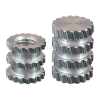
The course external thread of SPIROL's Self-Tapping Insert forms an internal thread within a molded or pre-drilled hole during the installation process into a plastic assembly.  SPIROL Series 10 Self-Tapping Inserts are thread forming Inserts best suited for softer thermoplastics or thermosets.

Self-Tapping Inserts provide the best pull-out resistance for a post-mold installed Insert, yet generally cost more than their post-mold counterparts. The external threads are designed with a thin profile to minimize induced stress in the plastic and have a relative coarse pitch to provide the maximum plastic shear surface to resist pull-out.

Installation torque is not a problem in that tightening increases the friction between the plastic and threads, and the larger diameter of the external Insert thread increases the frictional surface. Back-out torque performance relies totally on the greater surface area of the external Insert thread and the tension between the threads and plastic.

If installation equipment is required, SPIROL also offers a comprehensive line of Insert Installation Equipment from manual to fully automatic modules, with or without out fixturing, to support your Threaded Insert assembly requirements.

Application Engineering Assistance: If you would like assistance in selecting the proper Threaded Insert for your plastic assembly, please Request Technical Support!  We are here to help!

Self-Tapping Threaded Inserts Product Listing

(Series 10)

Self-Tapping Inserts

SPIROL’s Series 10 Self-Tapping Insert is a thread-forming Insert designed for use in soft, flexible thermoplastics and thermosets. Series 10 Inserts are available in thread sizes ranging from M3 (4-40) up to M6 (1/4-20).


Additional Threaded Insert Types
Customizable Solutions

If you are unable to find the Threaded Insert in the thread size, length, material, finish or quantity that you require within our standard offering, or if you are unsure what Insert is most appropriate for your plastic assembly, Request Engineering Support and we will help you find the most cost-effective solution for your application.

Request Engineering Support

Local Design, Global Supply.

SPIROL has Application Engineers throughout the world to assist you in your designs, supported by state-of-the-art manufacturing centers and worldwide stocking facilities to simplify the logistics of delivering your product.

View All Locations

Frequently Asked Questions

We recommended starting with a temperature 50˚F (28˚C ) above the initial softening temperature for the plastic in question. For plastics with fillers, this initial differential should be increased to around 150˚F (83˚C). Pressure is Insert-size dependent and should be as low as possible in the 5 to 15 PSI (0.03 to 0.10 Mpa) range. The pressure should be just enough to push the Insert into the hole as the plastic melts.
Technically you can use a soldering iron to install Inserts, but it is MOST DEFINITELY not a good idea. You won’t get a repeatable insertion depth, you will likely not install the Insert straight into the hole, and you will not have control over pressure. Also, many soldering irons are not available with a variable temperature setting.
The only way to verify Insert performance is to test the assembly. This is a destructive test. Section the plastic component with the installed Insert in half then remove the sectioned Insert out of the hole and ensure that the features of the Insert are mirrored in the plastic. It is extremely important to ensure proper plastic flow into the features of the Insert as this dictates the torque and pull-out performance. If the plastic did not sufficiently flow into the retention features, the result will be lower Insert performance. SPIROL's Inserts for Plastics Design Guide offers more detailed information about this.
Despite the cost of steel typically being less expensive than brass or aluminum, it is more difficult to machine and steel chews through tooling quicker than brass and aluminum. ALSO, steel Inserts typically require some kind of plating for corrosion resistance which further increases the cost of the Insert and the potential of quality defects due to plating a threaded part – not to mention the potential of mixed product due to the plating process.
This is impossible to answer without testing in your actual assembly. The following factors affect performance: Insert type, design within type & quality of features. Plastic specifications. Design & quality of the plastic components including hole tolerance & consistency. The installation process and quality thereof. In addition, there are so many different types of plastics and fillers (and percentage and orientation of those fillers within the plastics) coupled with the complexity of component design makes it impossible to provide Insert performance data which can be applied to specific applications. SPIROL provides a section in our Inserts for Plastics Design Guide that displays the performance of various style Inserts installed into Nylon 6/6 without fillers in drilled versus molded holes. The performance data is provided as a comparative guide between Insert types -> not to provide the actual performance that will be achieved in a specific application. For this, you will need to test!
Have a Question? We're Here to Help!

Have a manufacturing issue you can't solve? Our engineering experts love a challenge. Recommending efficient solutions for your application requirements is what we do best. Give us a call or fill out the form below to connect with us!

+1 860 774 8571